Google’s $15B AI & Data Centre Hub in India: What It Means for Visakhapatnam, India, and Global AI Infrastructure
Google’s announcement of a $15 billion Artificial Intelligence (AI) and data centre hub in Visakhapatnam, Andhra Pradesh, marks its largest-ever investment in India. This transformative project, spread across five years (2026–2030), aims to make India a central node in the global AI infrastructure network. The initiative combines gigawatt-scale data capacity, clean energy development, and global fiber connectivity, reflecting Google’s long-term vision of sustainable, large-scale AI deployment.
Overview of Google’s $15 Billion AI Hub
The new facility, called the Google AI Hub India, will be built in the port city of Visakhapatnam. It will host 1 gigawatt of computing infrastructure powered by renewable energy sources such as solar and wind projects. The hub will serve as a cornerstone for Google’s global AI cloud services, supporting advanced applications including generative AI, cloud computing, large language models (LLMs), and data analytics.
Prime Minister Narendra Modi and Google CEO Sundar Pichai jointly announced the plan, underlining the project’s alignment with India’s goal to become a global digital leader. The facility is set to accelerate India’s AI transformation and bolster foreign direct investment (FDI) inflows.
Partnership with Airtel and Adani Group
Google is collaborating with Bharti Airtel and AdaniConneX to bring this mega project to life.
- Airtel’s Role: The telecom giant will develop a high-capacity fiber network and a Cable Landing Station (CLS) in Visakhapatnam. This undersea network will connect India to Google’s global subsea cable system, improving data speeds and resilience for millions of users.
- AdaniConneX’s Role: A joint venture between Adani Enterprises and EdgeConneX, AdaniConneX will co-develop the core data centre infrastructure and invest in green energy, storage, and new transmission lines to ensure 24/7 sustainable power for the facility.
Infrastructure and Sustainability Plans
The Visakhapatnam AI hub will be part of Google’s broader strategy to expand eco-friendly AI infrastructure worldwide. It will integrate clean energy systems capable of powering the 1 GW facility with zero net carbon emissions. Plans also include an international subsea gateway to link Visakhapatnam to Google’s massive fiber network across Asia-Pacific, Europe, and North America.
Officials project that the project will generate over 180,000 jobs, including direct roles in data operations, IT engineering, energy management, and construction. Over time, it will also create thousands of indirect employment opportunities in logistics, power supply, and digital services.
Strategic Importance for India
The investment cements India’s growing status as a critical hub for global AI development and data services. With Visakhapatnam rising as a port-based tech city, the project supports regional economic diversification away from traditional manufacturing toward information technology and high-performance computing fields. It will also position India alongside Singapore, Malaysia, and the U.S. as part of Google’s global data centre ecosystem.
Furthermore, this multi-billion-dollar initiative signals deeper strategic cooperation among Google, Indian government bodies, and private corporations to strengthen AI infrastructure, cybersecurity, and affordable cloud access for businesses and start-ups nationwide.
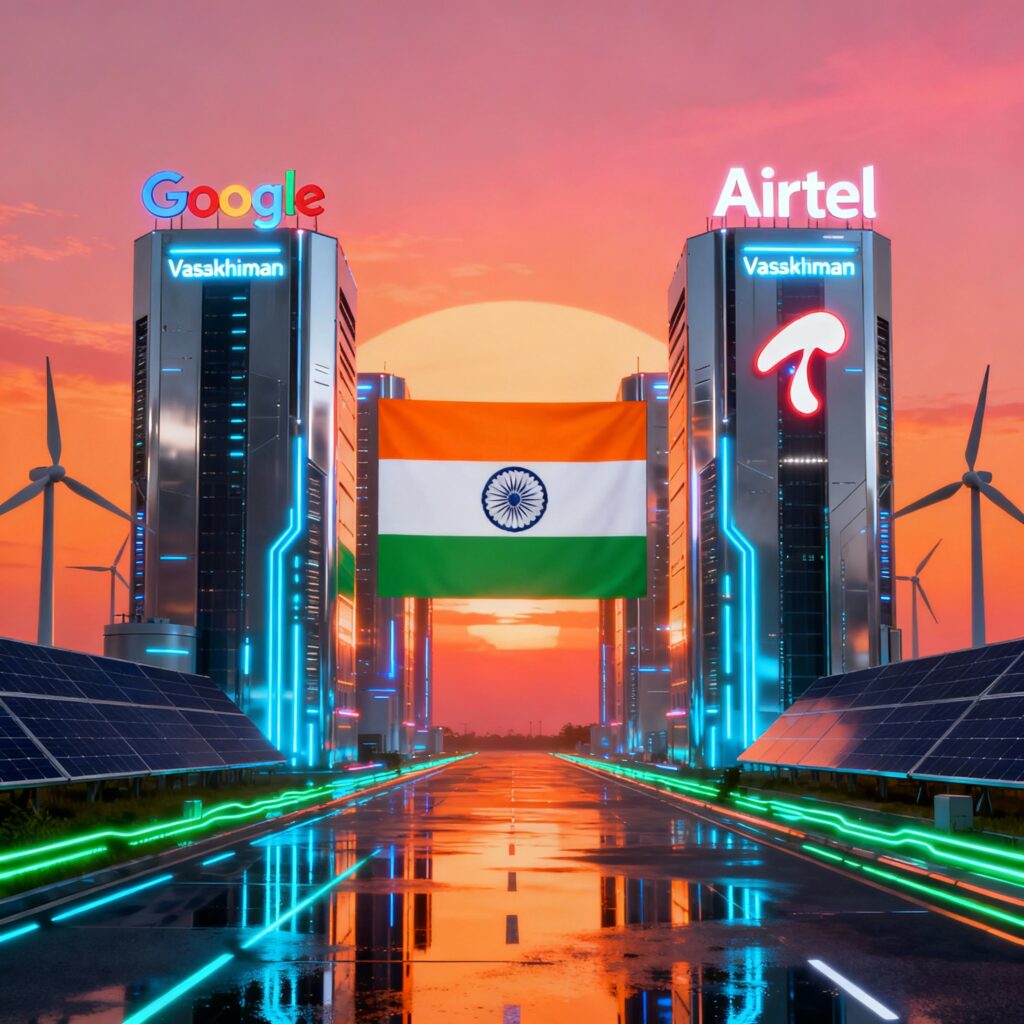
Google has just launched one of the most ambitious infrastructure investments ever in India: a US$ 15 billion commitment over five years to build a high-scale AI hub and data centre campus in Visakhapatnam, Andhra Pradesh. This marks Google’s largest investment outside the U.S. in AI infrastructure. The project spans gigawatt-scale compute, clean energy systems, subsea connectivity, and partnerships with Indian firms such as AdaniConneX and Bharti Airtel.
In this post, we’ll walk through what exactly this hub entails, why Google picked Vizag (Visakhapatnam), how the project will be structured, what impact it might have for India (especially Andhra Pradesh), and the risks & challenges that lie ahead.
Project Overview: What Google Is Building
Scale and Scope
- Google will invest about US$ 15 billion over a five-year period (2026–2030) to build the AI infrastructure hub in Visakhapatnam. blog.google+4IANS News+4mint+4
- The core data centre campus is expected to have a gigawatt-scale capacity (i.e. ~1 GW of compute / power scale) to support AI workloads. TRT World+4mint+4IANS News+4
- The hub is being called Google’s largest AI hub outside the U.S. Hindustan Times+4mint+4IANS News+4
- Beyond just data centre hardware, the project includes:
• A new international subsea cable gateway (i.e. landing one or more submarine fiber cables) to enhance global connectivity. Modern Diplomacy+3blog.google+3IANS News+3
• An expanded internal fibre network (intra-city, inter-city links) to connect the hub with fiber backhaul. Hindustan Times+3The Times of India+3blog.google+3
• Clean energy infrastructure: co-investment in new transmission lines, renewable energy generation, energy storage to support the data centre and improve grid resilience. Modern Diplomacy+4IANS News+4The Financial Express+4
Partnerships & Stakeholders
- Google is collaborating with AdaniConneX, a joint venture involving the Adani Group, to build and operate the data centre infrastructure. The Financial Express+4IANS News+4Moneycontrol+4
- Bharti Airtel is also part of the partnership. Airtel will help with fibre networks, connectivity, and embedding Google’s AI and cloud stack in India. blog.google+3Moneycontrol+3IANS News+3
- Google’s internal team (Google Cloud) will supply the AI stack, cloud services, and operational oversight. blog.google+2TechCrunch+2
- The Andhra Pradesh state government and central government are also involved (policy, land, incentives) through memoranda of understanding (MoUs). Google Cloud Press Corner+4The News Minute+4mint+4
Location: Why Visakhapatnam (Vizag)?
Choosing Visakhapatnam is strategic for multiple reasons:
- Geographic advantage for subsea connectivity
Visakhapatnam lies on India’s eastern coast, making it suitable for submarine cables linking to Southeast Asia, East Asia, Australia, etc. The new submarine cable gateway will diversify India’s landing points beyond Mumbai and Chennai. TRT World+4blog.google+4Modern Diplomacy+4 - Land availability and infrastructure
The region around Vizag and Rambilli has been earmarked for large tech parks, data centre campuses, and infrastructure projects. TRT World+3The Times of India+3The News Minute+3 - State policy & incentives
Andhra Pradesh’s government has actively pushed for large tech investments and data centre policies, aiming to become a hub for digital infrastructure. IANS News+3The Times of India+3mint+3 - Proximity for India’s east & Northeast
An eastern connectivity point reduces latency and improves redundancy for users in eastern and northeastern India and helps link with Southeast Asia.
Technical & Infrastructure Details
Compute / Data Centre Design
- The facility will be designed specifically to handle AI workloads, which demand high power, cooling, and networking. Google notes it will deploy its full AI stack at this hub. The News Minute+2blog.google+2
- To support this, the data centre will require massive power, cooling, and redundancy systems. Clean energy and energy storage are key parts of the plan. Hindustan Times+3IANS News+3blog.google+3
- The infrastructure will also include new transmission lines to carry power from clean energy sources into the data centre and support grid resilience. IANS News+1
Network & Connectivity
- The subsea cable gateway will act as a landing station for international cables, giving redundancy and direct paths to global networks. Google Cloud Press Corner+3blog.google+3Modern Diplomacy+3
- The hub will connect into Google’s global terrestrial and submarine backbone. blog.google+2Modern Diplomacy+2
- Within India, the hub will link with fiber optic networks (intra-city and intercity) to ensure low-latency access for Indian customers and AI applications. The Times of India+2blog.google+2
Energy & Sustainability
- Given the power intensity of AI and data centres, Google and its partners plan to co-invest in renewable energy generation (solar, wind, etc.) to supply the facility. Moneycontrol+3IANS News+3blog.google+3
- Energy storage systems will be deployed to buffer and stabilize supply, especially given variability in renewable output. Modern Diplomacy+3IANS News+3Moneycontrol+3
- By investing in the local grid (new transmission lines, perhaps upgrades), the hub also aims to bolster grid resilience and capacity in Andhra Pradesh. IANS News+2The Financial Express+2
Economic, Social & Strategic Impact
Job Creation & Economic Boost
- The project is projected to create ~1.88 lakh (188,000) direct and indirect jobs. The Times of India+2Reuters+2
- Some reports estimate 5,000–6,000 direct jobs in the initial phase and 20,000–30,000 total jobs (including ancillary services). The Hans India
- The hub is expected to significantly increase economic activity in Visakhapatnam, Andhra Pradesh, and the surrounding region. The Times of India+2The Indian Express+2
- It may act as a magnet for other tech investments, turning Vizag into a full-fledged AI / cloud / tech cluster over time. The Times of India+2The Indian Express+2
Strategic & Geopolitical Dimensions
- For Google, the move helps localize AI and cloud infrastructure in India, reducing dependency on foreign (especially U.S.) locations and improving latency for Indian users. Modern Diplomacy+2blog.google+2
- It strengthens India’s role in global AI infrastructure networks, especially in the Indian Ocean / Southeast Asia region.
- The move comes at a time of friction in U.S.–India trade / technology relations, and signals that Google is doubling down on India as a strategic market. Reuters+2Modern Diplomacy+2
- From India’s perspective, the hub supports ambitions of digital sovereignty, infrastructure self-reliance, and elevating India’s place in the global tech map. AP News+2The Indian Express+2
Boosting AI Adoption & Innovation
- With local AI compute infrastructure, Indian startups, enterprises, research labs, and developers can access high-capacity resources with lower latency, better cost, and regulatory compliance. blog.google+2The Financial Express+2
- This could fuel growth in generative AI, large language models, computer vision, scientific computing, and domain-specific AI applications in India.
- It also aligns with governmental policy pushes in India toward AI adoption, digital public infrastructure, and making India a global AI hub.
Challenges, Risks & Questions
While this is a landmark project, several challenges must be managed for its success:
- Regulatory & Policy Uncertainty
India has evolving policies around data localization, digital sovereignty, foreign tech firms, taxation, and national security. Ensuring regulatory stability will be critical.
Some commentators note that Google’s commitment will be watched under antitrust / regulatory lenses. www.ndtv.com+1 - Power / Energy Constraints
Meeting the energy demands of a 1 GW (or more) AI hub is nontrivial. Integration with renewables, storage, grid upgrades may face delays or technical constraints.
Ensuring clean energy supply without conflicting with local needs or causing grid stress is a challenge. - Infrastructure & Connectivity Risks
Building a subsea landing station, fiber network, and integration with global networks involves huge civil, marine, and engineering complexity. Cable delays, right-of-way issues, terrain challenges, etc., could slow progress. - Cost Overruns & Delays
Large infrastructure projects often face cost escalation, delays, and logistical hurdles (land acquisition, permitting, supply chain). - Local Skill / Human Resources Gap
To run and maintain such a hub, India will need a skilled workforce (data centre operations, AI engineers, network engineers, etc.). Ensuring enough human capital and training pipelines is essential. - Concentration risk
Placing such a huge investment in one city (Visakhapatnam) may create regional imbalances or vulnerabilities. Having redundancy and spreading infrastructure is wise. - Geopolitical / Security Risks
International connectivity and data flows cross national boundaries, so issues like cable security, data privacy, and geopolitical pressures might arise.
Google’s $15 billion AI hub in Visakhapatnam is a bold bet on India’s future in artificial intelligence, cloud, and digital infrastructure. If executed well, it could transform the region into a global AI / tech hub, accelerate AI adoption across India, spur job creation, and enhance connectivity. But the scale also brings risk — from energy and regulation to execution and talent.
Over the coming years, how Google, its partners (AdaniConneX, Airtel), and Indian governments navigate these challenges will determine whether this becomes a landmark success or a cautionary tale.





Post Comment