SpaceX Acquires xAI: A $1.25 Trillion Mega-Merger That Reshapes AI and Space Technology
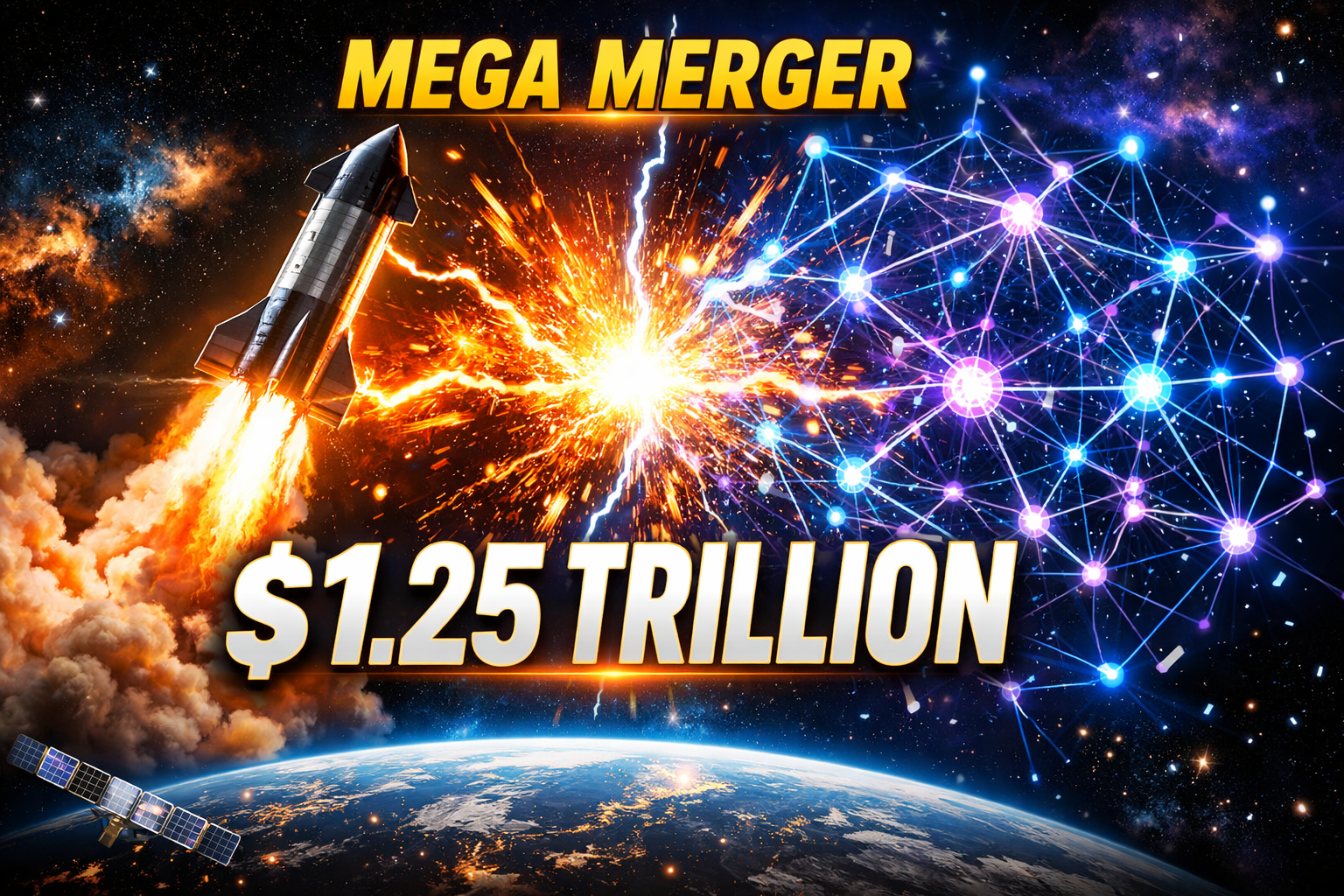
Elon Musk has announced the merger of SpaceX with xAI, creating a combined entity valued at $1.25 trillion—forming what he calls “the most ambitious, vertically-integrated innovation engine on (and off) Earth.” This historic consolidation brings together space rockets, satellite internet, AI development, and social media into a single corporate structure, with plans for a major IPO in mid-2026. The merger’s core rationale: terrestrial data centers cannot sustainably power the AI revolution, but space-based alternatives can.
The Deal – What Just Happened?
On February 2, 2026, Musk announced the acquisition through share swap, valuing the combined entity at $1.25 trillion with expected share pricing at $526.59 each. This unifies an unprecedented technology portfolio:
- SpaceX’s Falcon 9 & Starship rockets – the only American vehicles routinely ferrying astronauts to the ISS and primary NASA/DoD launch providers
- Starlink constellation – 9,000+ satellites generating ~$8.2 billion in annual revenue (63% of SpaceX total revenue)
- xAI’s Colossus supercomputer – world’s largest AI supercomputer with 230,000+ GPUs
- Grok AI chatbot – conversational model competing with ChatGPT and Claude
- X (formerly Twitter) – social platform with 500+ million users
- Direct-to-mobile communications – emerging Starlink D2C service
- Real-time data platform – X as training data source for AI
The merger was announced internally via memo and confirmed on SpaceX’s website, executed with remarkable speed—just days after speculation emerged late January.
The Strategic Rationale – Why Merge Now?
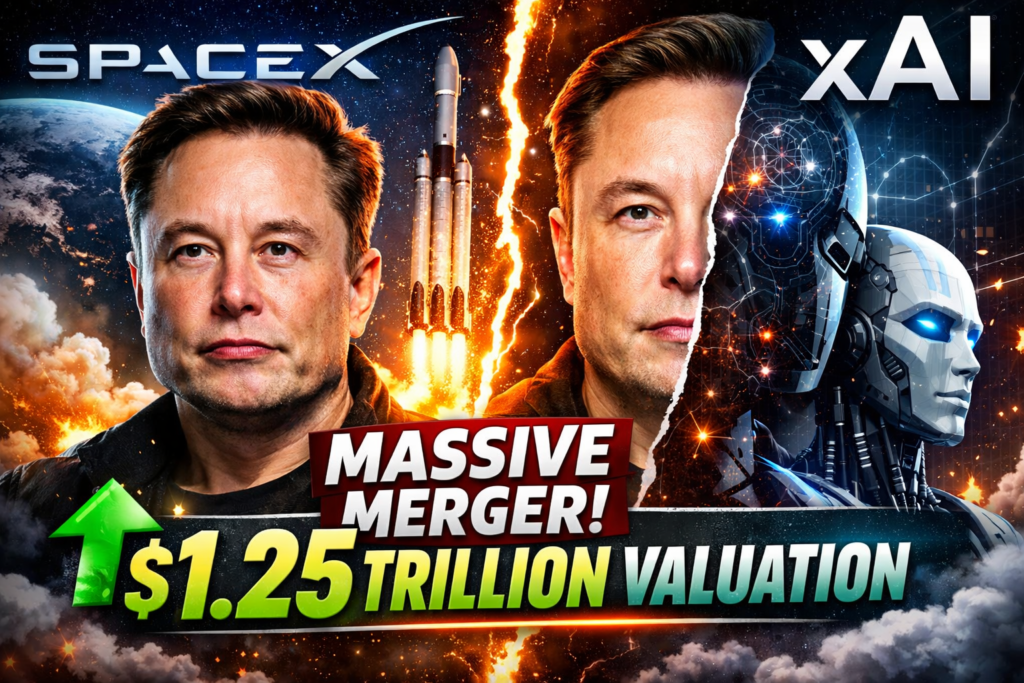
The Space-Based AI Data Center Thesis
The merger’s core premise is audacious: terrestrial data centers cannot sustainably power AI. According to SpaceX’s official statement:
“Current advances in AI are dependent on large terrestrial data centers, which require immense amounts of power and cooling. Global electricity demand for AI simply cannot be met with terrestrial solutions, even in the near term, without imposing hardship on communities and the environment.”
At Davos earlier this year, Musk elaborated: “My estimate is that within two to three years, the lowest cost way to generate AI compute will be in space.”
How Orbital Computing Works (Theoretically):
- Unlimited Solar Power – Satellites in high orbits receive constant sunlight, eliminating nighttime and cloud cover, providing near-infinite clean energy
- Frictionless Cooling – Space’s extreme temperatures and vacuum enable direct thermal dissipation without infrastructure
- Starship Advantage – SpaceX’s fully reusable heavy-lift vehicle can transport massive payloads at dramatically lower costs than competitors
- Synergistic Integration – End-to-end control eliminates intermediaries and coordination costs
This is explicitly competitive against:
- Google – advancing Project Suncatcher with Planet Labs (target 2027)
- Microsoft & Amazon – committing hundreds of billions to ground-based centers
- China – planning “Space Cloud” by 2030
Vertical Integration Philosophy
The merger exemplifies Musk’s full-stack strategy: controlling entire value chains from raw materials through end-user product. This creates:
Cost Control: Eliminating vendor dependencies reduces input costs and improves long-term margins
Speed & Flexibility: Co-optimizing hardware with software enables efficiency gains of 2-3× impossible with commodity components
Defensible Moat: Vertical integration makes competitive replication nearly impossible
Data Flywheel: Proprietary X platform data (real-time signals from 500+ million users) provides training advantages static datasets cannot match
Financial Implications and IPO Strategy
The $1.25 Trillion Valuation in Context
The combined entity valuation places it at exceptional scale:
- Apple: ~$3.2 trillion
- Microsoft: ~$3 trillion
- NVIDIA: ~$2.5 trillion
- Alphabet: ~$2.1 trillion
- Saudi Aramco: ~$2.3 trillion
- SpaceX-xAI: $1.25 trillion
For comparison, SpaceX alone was valued at ~$800-900 billion in recent private markets, while xAI raised at $230 billion valuation in January 2026’s $20 billion Series E round.
The jump reflects both companies’ combined potential weighted heavily on speculative long-term scenarios: Starlink’s profitability path, orbital data center commercialization, xAI’s AI model adoption, and synergistic integration value.
IPO Strategy
Timeline: Mid-2026 (possibly June)
Expected Raise: $30-50+ billion (potentially largest IPO in history)
Share Price: ~$527 (internal memo figure)
- Liquidity for early investors after decades of private operation
- Public equity currency for future acquisitions
- Valuation ceiling (avoiding unsustainable private valuations)
- Talent attraction via liquid stock compensation
However, it carries substantial risks (detailed in risks section).
The Colossus Supercomputer – The Operational Proof-of-Concept
Scale and Specifications
xAI’s Colossus, located in Memphis, Tennessee, in a former Electrolux factory, represents the most aggressive AI infrastructure deployment in history:
Deployment Speed:
- July 2024: 100,000 NVIDIA H100 GPUs in just 122 days (industry estimated 18-24 months)
- December 2025: Doubled to 200,000 GPUs
- Current: 230,000 total GPUs (150,000 H100s + 50,000 H200s + 30,000 GB200s)
- Future target: 1 million GPUs
Power: ~250 megawatts from Memphis grid with Tennessee Valley Authority backing
Technology:
- Liquid cooling systems (Supermicro 4U)
- NVIDIA Spectrum-X Ethernet achieving 95% throughput (vs. 60% traditional)
- Tesla Megapacks for battery backup
For the merger, Colossus serves as:
- Training infrastructure for Grok
- Operational credibility showcase for IPO
- Quantifiable asset on balance sheet
- Bridge technology while orbital alternatives develop
Competitive Landscape – The AI IPO Race
Competing Ventures
- Valuation: ~$1 trillion
- IPO Timeline: Q4 2026
- Status: $100 billion pre-IPO round from Amazon, SoftBank, NVIDIA
- Challenge: $10+ billion annual burn, unprofitability
Anthropic (Amazon/Google-backed)
- Valuation: $300+ billion
- IPO Timeline: Early-mid 2026
- Status: Hired Wilson Sonsini for IPO preparation
- Advantage: Projected profitability by 2028 vs. OpenAI’s 2030
Space-Based Computing Competition
Google Project Suncatcher – Partnership with Planet Labs; prototype launch ~2027
China “Space Cloud” – Target deployment 2030-2032 via China Aerospace Science and Technology
Amazon/Others – Building Kuiper constellation but haven’t committed to orbital data center scale
Grok – Market Position in the AI Chatbot Landscape
Rapid Growth
Grok has achieved notable market penetration for a nascent AI model:
Market Share Growth:
- Grew from 0% to 3.4% in one year
- Ranks on par with DeepSeek (3.7%), China’s alternative
- Nearly doubled market share in past three months alone
Comparative Landscape:
- ChatGPT: ~35% (down from ~55%; still dominant)
- Google Gemini: ~20-25% (rapidly gaining)
- Claude (Anthropic): ~10-15% (second strongest)
- Grok: ~3.4% (emerging, accelerating)
- DeepSeek: ~3.7% (Chinese, cost-focused)
Grok’s Advantages and Limitations
Advantages:
- Direct integration with X platform’s 500+ million users
- Real-time training data from platform
- Dedicated Colossus compute for rapid iteration
- High-profile Musk promotion driving awareness
Limitations:
- Perceived as having fewer safety guardrails (concerns for enterprises)
- Still trailing in enterprise adoption vs. ChatGPT/Claude
- Model capabilities may not lead in standardized benchmarks
- Primarily consumer-focused via X rather than enterprise channels
Technical Feasibility – The Reality Check
The Optimistic Pathway
SpaceX-xAI claims orbital data centers are viable within 2-3 years through:
Phase 1 (2026-2027): Develop radiation-hardened components; design thermal management; conduct prototype missions
Phase 2 (2027-2028): Deploy initial constellation (~100+ satellites); establish laser inter-satellite links; demonstrate cost advantages
Phase 3 (2029+): Thousands of compute satellites; “at-source” AI workload processing; dramatic cost reductions
Significant Technical Challenges
Despite optimism, substantial hurdles remain:
Radiation Damage – Space radiation degrades semiconductors faster than Earth; radiation-hardened chips lag performance by 1-2 generations; frequent satellite replacement required
Launch Costs – Even Starship deployment costs orders of magnitude more than terrestrial facilities; economics depend on achieving sub-$2 million per-flight costs (current estimates: $15-100 million range)
Maintenance Impossibility – Unlike terrestrial data centers, orbital facilities cannot be easily repaired or upgraded; dead satellites represent sunk capital
Bandwidth Limits – Space-to-ground communication is constrained by spectrum and antenna technology; not all AI workloads can run in space
Space Debris – Growing debris threatens any orbital infrastructure; collision damage to a billion-dollar satellite is catastrophic
Regulatory Uncertainty – Spectrum allocation conflicts with terrestrial networks; no clear regulatory framework; FCC, FAA, international bodies must approve
Expert Consensus: Most aerospace and computing experts believe orbital computing will eventually serve specific use cases (satellite imagery processing, edge computing) but widespread AI training in space remains aspirational for 5-10+ years. Musk’s 2-3 year timeline is widely considered aggressive.
Regulatory and Market Risks
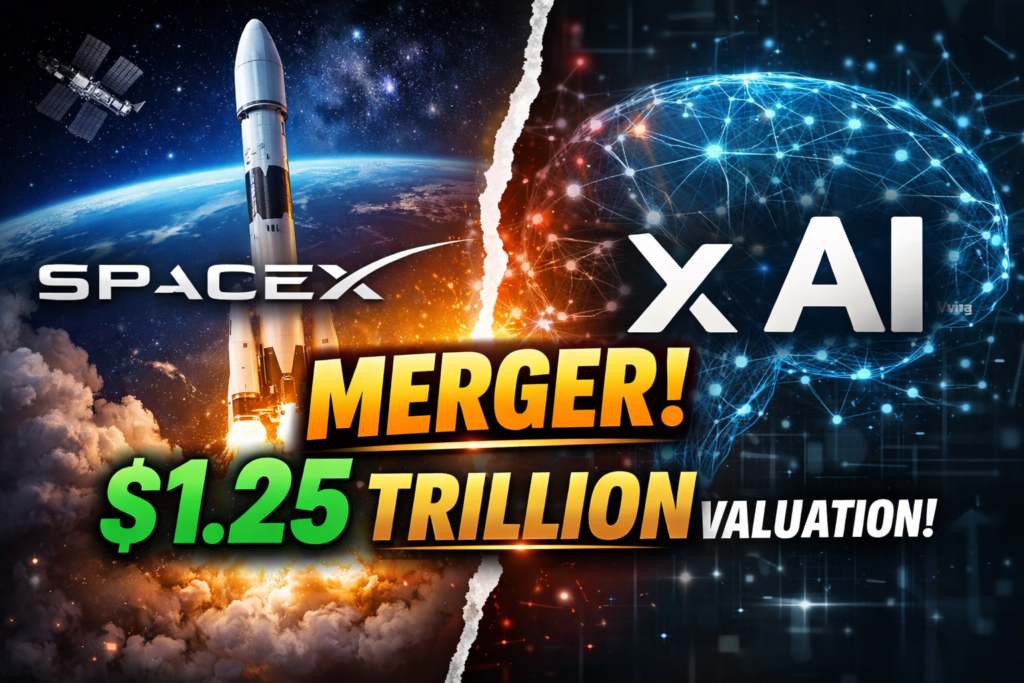
The AI Bubble Concern
Critical question: Is AI in a speculative bubble?
Evidence Supporting Bubble:
- Bank of England warned of overvaluation risk; OpenAI valuations tripled in 12 months ($157B to $500B)
- Jared Bernstein (former Biden economic advisor): “OpenAI has engaged in ~$1 trillion AI transactions yet is forecasted to generate only $13 billion in revenue”
- By 2030, AI companies will need $2 trillion annual revenue to finance required computing—but Bain & Co. projects actual revenue will fall short by $800 billion
- MIT research: 95% of organizations report no return on AI investments
- Comparisons to late-1990s dot-com bubble dynamics
Mitigating Factors: Unlike dot-com, the largest AI backers (Google, Microsoft, Amazon, Meta) have substantial revenue streams and cash reserves, reducing systemic risk.
Impact on IPO: If AI bubble corrects before mid-2026 IPO, $1.25 trillion valuation could contract 50-70%. The deal assumes sustained AI enthusiasm and orbital computing viability.
Regulatory Hurdles
SEC Scrutiny:
- Combined entity must demonstrate standalone viability
- Complex intercompany contracts (IP licensing, launch services) must withstand disclosure requirements
- Musk’s SEC settlement history may invite skepticism
FCC & FAA:
- Spectrum allocation requires FCC approval
- Launch frequency increases need FAA clearance
- Orbital debris mitigation requirements
- International coordination needed
EU Concerns:
- X under investigation for Digital Services Act content moderation compliance
- If EU imposes operational constraints on X, impacts AI training data availability
- Skepticism toward Musk-controlled infrastructure
National Security:
- U.S. defense agencies use SpaceX; orbital infrastructure raises sovereignty questions
- Congressional oversight likely
- China may demand competitive capability
Concentration of Power Risk
A $1.25 trillion entity under Musk control raises unprecedented concerns:
- Owns primary U.S. space launch capability
- Controls global satellite internet infrastructure
- Dominates AI compute resources
- Owns major social platform (X)
- Controls real-time information distribution
Antitrust concerns are probable if SpaceX-xAI uses integrated advantages to preference Musk-controlled services or undercut competitors.
Financial Performance and Path to Profitability
Current Revenue Profile
SpaceX Total Revenue (2024): ~$13.1 billion
- Starlink: $8.2 billion (63%)
- Launch services: $4-5 billion
- Other services: $0.9 billion
- 2024: $8.2 billion
- 2025 (projected): $11.8 billion
- 2026 (projected): $15.9 billion
- 2027 (projected): $20+ billion
- Projected 2026 EBITDA: ~$11 billion; Free Cash Flow: ~$5 billion
xAI:
- Burns ~$1 billion monthly (~$12 billion annually)
- Zero significant revenue yet (experimental phase)
- Minimal Grok enterprise revenue
X (Social Media):
- 2024 Revenue: ~$3 billion (declining from pre-acquisition due to advertiser hesitation)
- Trend: Stabilizing but not growing significantly
Profitability Timeline
Short Term (2026-2027): SpaceX/Starlink profitable; xAI continues burning cash; combined entity likely profitable on SpaceX contribution alone
Medium Term (2028-2030): Starlink reaches sustained profitability ($20+ billion revenue); xAI either finds product-market fit or continues scaling; orbital pilots begin generating revenue (if feasible); X monetization improves
Long Term (2031+): If orbital computing succeeds, could generate $50+ billion annual revenue; xAI becomes enterprise standard; integrated ecosystem creates defensible position
Critical Dependency: Entire narrative hinges on orbital computing becoming economically viable. Without it, company defaults to SpaceX/Starlink as cash engine and xAI as cost center—reducing strategic synergy justification.
Alternative Angles and Deeper Implications
Elon Musk’s Concentration of Power
This merger represents extraordinary concentration of wealth and influence:
- Controls ~60% of SpaceX directly/via trusts
- CEO of SpaceX, xAI, Tesla (board), Neuralink (board), The Boring Company
- Operates within SEC, FAA, FCC oversight
- Already polarizing figure; consolidation amplifies power concentration risk
Historical Echo: In 2013, Musk nearly went bankrupt after 2008 financial crisis, having poured personal wealth into Tesla and SpaceX. The current $1.25 trillion bet echoes that “all-in” mentality at infinitely larger scale.
If IPO Succeeds at Current Valuation: Musk’s net worth could exceed $500 billion—wealthier than any individual in history—raising governance and regulatory capture concerns.
Strategic IPO Advantage
Why SpaceX-xAI May Win the IPO Race:
- Tangible assets, revenue, operational track record (vs. pure AI startups)
- Starlink provides profitable recurring revenue (stability)
- Orbital computing vision more technically novel than competitor scaling narratives
- Musk’s brand attracts retail enthusiasm
Why Being First Matters:
- First major AI IPO sets valuation multiples and investor frameworks for entire category
- Public market capital is “cleaner” than private equity (fewer strategic strings)
- Establishes narrative dominance (“space-based AI is future” vs. traditional cloud)
If SpaceX-xAI IPO succeeds, it validates vertical integration + space-tech thesis, likely driving OpenAI/Anthropic valuations upward. Conversely, struggle signals skepticism about orbital computing and could cool entire AI IPO boom.
X Platform as Strategic Asset
Often overlooked, X plays critical role:
Data & Training: Real-time user content provides unique training signals vs. static historical datasets; 500+ million users generate continuous feedback for model improvement
Distribution: Grok embedded in X attracts users (evidenced by 3.4% market share gain); future AI features deploy directly to audience
Geopolitical Implications: X is primary real-time information platform in U.S., increasingly global; integrated with AI compute + satellite infrastructure, becomes powerful information distribution tool with potential for beneficial (disaster response) or harmful (misinformation) outcomes
What Could Go Wrong? Risk Scenarios
Technical Execution Risks
Orbital Computing Delays – If space-based data centers take 5-7 years instead of 2-3, strategic rationale weakens; terrestrial alternatives may close gap
Radiation-Hardened Compute Limitations – If available chips significantly underperform, cost-benefit calculus changes
Starship Failures – Test failures could delay orbital infrastructure deployment; SpaceX’s heavy dependence on continued Starship success
Market & Competitive Risks
AI Model Commoditization – Open-source models (Llama, etc.) matching Grok capability reduce enterprise customer reasons to pay for xAI services
Cloud Provider Response – Amazon, Google, Microsoft invest in alternative cooling, renewable energy, distributed architectures rather than accepting orbital dominance
Starlink Cannibalization – If compute infrastructure conflicts with broadband mission (antenna conflicts, power budgets, spectrum), synergy evaporates
Regulatory & Geopolitical Risks
Spectrum Conflicts – FCC allocations; international negotiations delay deployment years
National Security Restrictions – Government limits on private orbital AI compute; export controls prevent Grok monetization in certain markets
EU Regulatory Action – Digital Services Act enforcement against X; GDPR concerns about satellite data processing; potential fines or service restrictions
IPO & Market Risks
AI Bubble Correction – Enthusiasm collapse pre-IPO drives 50-70% valuation contraction
Lockup Period Selling – Post-IPO employee equity lockup expiration could trigger massive selling pressure
Integration Execution – Combining SpaceX engineering culture + xAI research culture notoriously difficult; potential leadership conflicts, talent exodus
Concentration & Governance Risks
Musk Distraction – Already manages Tesla, Neuralink, Boring Company; divided attention reduces execution quality
Regulatory Backlash – $1.25 trillion concentration may invite antitrust action; forced breakup or operational restrictions
Looking Forward – What This Means
For Investors
Bull Case (Valuation Justified):
- Orbital computing becomes economically viable by 2028-2029
- SpaceX-xAI captures first-mover advantage, establishes insurmountable lead
- Starship achieves stated cost targets
- X becomes AI-enhanced platform; Grok becomes enterprise standard
- Combined entity worth $2-5 trillion by 2030
Bear Case (Valuation Speculative):
- Orbital computing remains aspirational 10+ years
- Competitors catch up; no structural advantage emerges
- AI commoditization reduces Grok’s moat
- Regulatory delays prevent deployment
- Bubble correction drives IPO failure; shares trade significantly below $527 by 2027
Most Likely Outcome:
- Orbital computing becomes real but slower/more expensive than promised
- Starlink remains cash engine; xAI becomes profitable but modest
- IPO prices ~$1.0-1.2 trillion; shares stabilize at reasonable multiples
- Company succeeds but underwhelms initial hype
For the Space and Tech Industries
This merger accelerates key trends:
- Vertical Integration as Necessity – Companies increasingly must own entire stacks (chip design, data, compute, software)
- Space as Business Infrastructure – Space transitions from government/telecom domain to central AI, energy, manufacturing component
- Unlimited Compute Availability – If orbital computing works, effectively unlimited compute enables exponentially larger models and new AI capabilities
- Geopolitical Implications – U.S. space + AI dominance creates strategic advantage vs. China; raises espionage/security concerns; international coordination becomes critical
For Society
This merger raises profound governance questions:
Concentration of Power: Should single individual control space launch, satellite internet, AI compute, and social media?
Energy and Environment: Is orbital computing environmentally better (less grid demand, less cooling water) than terrestrial despite space debris and launch pollution?
Information Control: X + AI compute + satellite infrastructure = unprecedented information distribution capability; dual-use (beneficial connectivity vs. manipulation potential)
Technological Future: If successful, space becomes next computing frontier (as cloud was in 2000s-2010s); also enables Mars colonization (Musk’s stated goal) via sustainable off-Earth infrastructure
Elon Musk Unites SpaceX and xAI in a $1.25 Trillion Giant: What It Means for Space, AI, and the Future IPO
Elon Musk has made yet another bold move: SpaceX is merging with his artificial intelligence company xAI, creating a combined powerhouse reportedly valued at around $1.25 trillion. This merger doesn’t just reshape Musk’s own empire—it could redefine the future of space exploration, AI development, and the global tech market, with a massive initial public offering (IPO) already on the horizon.
In one stroke, Musk is putting rockets and neural networks under the same roof. Here’s what that could mean for investors, technology, and the future of humanity’s reach into space.1. What Exactly Happened?
Elon Musk has announced a structural shake-up:
- SpaceX, already a dominant force in reusable rockets, satellites, and space logistics,
- is merging with xAI, his rapidly growing artificial intelligence venture,
- to form a single, integrated tech entity, informally valued at about $1.25 trillion.
This unified company is expected to combine:
- SpaceX’s physical infrastructure – rockets, launch pads, Starlink satellites, space manufacturing concepts, and Mars-focused R&D.
- xAI’s software intelligence – large language models, autonomous decision systems, and specialized AI for robotics and scientific computing.
The result is a company that doesn’t just launch hardware into orbit; it also thinks, learns, and optimizes every step of that journey using AI.2. Why Bring SpaceX and xAI Together?
Musk has long argued that AI and space are deeply connected to humanity’s long-term survival. The merger aligns three big ideas:
- Make life multiplanetary
SpaceX’s core mission is to enable human settlement on Mars and beyond. That goal requires:
- Smart robotics for construction and maintenance on other worlds
- Automated navigation and decision-making in deep space
- Real-time optimization of missions, fuel, and logistics
- Ensure AI benefits humanity
xAI’s stated goal is to build AI that “understands the universe.” Connecting that mission directly with space exploration gives xAI:
- Real-world, high-stakes problems to solve
- Massive streams of space and satellite data to learn from
- A clear purpose beyond just chatbots and enterprise tools
- Create a vertically integrated tech powerhouse
By merging, Musk is designing a company that controls:
- Hardware (rockets, spacecraft, satellites, ground stations)
- Software (AI models, autonomous systems, mission planning tools)
- Infrastructure (Starlink communications, space platforms, supercomputing clusters)
This kind of vertical integration makes it harder for competitors to catch up—and more attractive for future public investors.3. The $1.25 Trillion Valuation: Hype or Justified?
A valuation near $1.25 trillion immediately puts the combined entity in the same league as the world’s largest tech companies. How does that number make sense?Key Value Drivers
- SpaceX’s existing valuation
SpaceX has been valued in private markets at hundreds of billions of dollars, thanks to: - Falcon 9 and Falcon Heavy dominance in commercial launches
- The rapidly expanding Starlink satellite internet network
- NASA and commercial contracts for crewed and cargo missions
- xAI’s growth potential
xAI is seen as a potential rival to top AI labs, with: - Large-scale models that can be applied across industries
- Synergy with Musk’s existing platforms (like X/Twitter and hardware)
- The ability to embed AI deeply into SpaceX operations and Starlink services
- Synergy premium
Investors often pay a “synergy premium” when two complementary companies merge. In this case: - AI can dramatically reduce costs and risks in space operations
- Space data and Starlink connectivity can supercharge AI training and deployment
- The combined company can launch AI-enabled services globally, almost overnight, via satellite
Given these factors, the $1.25 trillion estimate is aggressive—but not unimaginable in a market that already values AI and space as transformative, trillion-dollar sectors on their own.4. Space + AI: Practical Applications of the Merger
This merger isn’t just a financial story—it’s a roadmap for how AI might run the future of space.4.1 AI-Powered Rockets and Missions
- Autonomous mission planning: AI could design flight paths, timing, and fuel usage more efficiently than human engineers.
- Predictive maintenance: Machine learning models could predict when rocket components are likely to fail, reducing launch delays and accidents.
- Fault detection in real time: During launches, AI systems could analyze sensor streams and detect anomalies faster than any human team.
4.2 Smart Satellites and Starlink Evolution
- Dynamic traffic management: AI can coordinate thousands of Starlink satellites to avoid collisions and optimize coverage.
- On-orbit AI processing: Instead of sending all data back to Earth, satellites could analyze images and signals locally using onboard AI chips.
- Ultra-optimized internet: xAI models could power smarter network routing, lower latency, and more personalized connectivity services worldwide.
4.3 AI-First Mars and Lunar Operations
- Robotic construction crews: AI-controlled robots could build habitats, power systems, and landing pads before humans even arrive.
- Autonomous exploration: Rovers and drones guided by xAI models could map new planets, identify resources, and make local decisions without waiting for commands from Earth.
- Life-support optimization: AI could manage oxygen, water recycling, agriculture, and energy usage in real time for off-world colonies.
5. What Could the IPO Look Like?
The announcement includes clear intent: a large future IPO is on the roadmap. That IPO, if it happens, would likely be one of the most watched in history.5.1 Why an IPO Now Makes Sense
- Capital for Mars and mega-projects: Building cities on Mars, expanding Starlink, and operating massive AI supercomputers requires staggering capital.
- Liquidity for early investors and employees: After years of private funding, an IPO could provide exits and reward long-time backers.
- Strategic independence: A public listing could reduce dependence on any single private investor or geopolitical funding source.
5.2 Challenges Before Going Public
- Regulatory scrutiny
A company dominating both critical space infrastructure and advanced AI is likely to face: - Antitrust questions
- National security concerns
- AI safety and data privacy regulation
- Complex corporate structure
Combining launch services, satellite internet, AI labs, robotics, and possibly defense contracts into one entity is difficult to explain and value for traditional investors. - Volatility risk
Both space exploration and AI are high-risk, high-reward fields. Markets may react sharply to failed launches, regulatory headlines, or AI-related controversies.
6. Impact on Competitors and the Global Tech Landscape
This merger sends a strong signal: the next generation of tech giants won’t just be software companies—they’ll own physical infrastructure and AI together.6.1 Space Industry Impact
- Traditional launch providers now face a competitor that:
- Innovates faster
- Uses AI to reduce costs and risk
- Monetizes space with internet, data, and AI services—not just launch fees
6.2 AI Industry Impact
- xAI gains a unique edge over other AI labs:
- Exclusive, high-value data from satellites and space missions
- Massive real-world deployment scenarios (Starlink, robotics, spacecraft)
- Tight integration with a global communications network
6.3 Geopolitical Implications
- A single private company controlling:
- Satellite internet across much of the globe
- Critical launch infrastructure
- Advanced AI systems
raises complex questions about national sovereignty, defense, and digital independence. Governments worldwide will likely watch this integration closely.7. Risks and Concerns
While the vision is powerful, the merger also brings significant risks.7.1 AI Safety and Control
- As AI is integrated into mission-critical systems (rockets, satellites, life support), the margin for error shrinks.
- Balancing speed of innovation with robust safety frameworks will be essential to avoid catastrophic failures.
7.2 Market Concentration
- The combined company could become too dominant across multiple domains:
- Launch services
- Satellite internet
- AI platforms
- Robotics and automation
- Regulators may push back against what could resemble a “super-monopoly” over core future infrastructure.
7.3 Execution Risk
- Integrating two high-pressure, fast-moving organizations is hard.
- Cultural clashes between aerospace engineers and AI researchers, misaligned timelines, and competing priorities could slow progress if not managed carefully.
8. What This Means for the Future of Humanity
Beyond valuations and IPOs, this merger is a statement about where technology is heading:
- AI will be everywhere, including space.
Space won’t just be about rockets and astronauts; it will be about intelligent systems making thousands of decisions per second, far from Earth. - Infrastructure will be intelligent by default.
Internet, transportation, energy, and logistics—on Earth and beyond—will increasingly be run by AI. - Private companies will shape long-term civilization projects.
The fact that a single private entity can aim to both colonize Mars and lead in AI shows how much power has shifted from states to corporations.
For Elon Musk, combining SpaceX and xAI is more than a financial maneuver—it’s a way to align his two grand projects: expanding human presence into the cosmos and building powerful AI that can help us understand and survive in it.9. Key Takeaways
- SpaceX and xAI are merging into a single company valued near $1.25 trillion, combining rockets, satellites, and advanced AI.
- The new entity aims for a large future IPO, likely one of the biggest and most closely watched in tech history.
- AI will be deeply embedded in launch operations, satellite networks, exploration robotics, and life-support systems for off-world missions.
- The merger raises enormous opportunities (efficiency, innovation, global connectivity) and serious risks (regulation, AI safety, market dominance).
- This is a defining moment in the shift from traditional tech to integrated “atoms + AI” mega-companies shaping the future on Earth and in space.
Conclusion – A Defining Moment in Technology
The SpaceX-xAI merger at $1.25 trillion represents one of the most ambitious and controversial technology consolidations in history. It combines space infrastructure, artificial intelligence, satellite internet, and social media into a vertically-integrated entity under Elon Musk’s control.
The merger’s thesis—terrestrial data centers cannot sustain AI; the solution is orbital—is both technically plausible and extraordinarily speculative. Technical hurdles are real, timelines aggressive, market risks substantial. But potential upside—if execution succeeds—is transformative.
For investors, this is a bet on three things: (1) orbital computing becomes economically viable, (2) Musk’s execution capability scales to this level, (3) SpaceX-xAI maintains competitive advantages against Google, Amazon, Microsoft, and competitors.
For industry, the merger signals space-based infrastructure is becoming as central to commerce as terrestrial networks. Others will race to follow or integrate with Musk’s ecosystem.
For society, the concentration of power—one individual controlling space access, global internet, AI compute, and major social platform—raises governance questions regulators and policymakers must address.
The mid-2026 IPO is the moment of truth. Will public markets validate the vision at $1.25 trillion? Or will skepticism over AI bubble concerns, orbital computing feasibility, and execution risks drive correction? The answer will shape AI development, space commercialization, and tech industry consolidation trajectories for the next decade.



Post Comment