AI will not replace humans. Humans who use AI will replace humans who don’t.
Crossing the Agentic Event Horizon
Humanity has passed the technological event horizon, and the takeoff of autonomous digital intelligence has officially started. The artificial intelligence landscape is currently undergoing its most significant reinvention in over a decade. If previous years were defined by modernizing data infrastructures and experimenting with generative text, 2026 represents the year technology becomes intelligent, conversational, and decisively action-oriented. The era of simple prompts and reactive chatbots is officially over, replaced by a new reality where digital systems do not merely talk—they act.
This topic is dominating industry discussions because the technological shift has decisively moved from experimental promise to measurable proof. Organizations are no longer content with isolated efficiency gains, generic piloting, or unmeasurable productivity boosts. Instead, the focus has shifted entirely to autonomous agents capable of independent task execution and complex, multi-variable decision-making. For modern enterprises and digital-first consumers alike, understanding this rapid evolution is not just relevant; it is a critical prerequisite for navigating the future of everyday technology.
The integration of artificial intelligence is no longer viewed as an optional add-on feature for software developers. Instead, it has become the foundational infrastructure powering applications, platforms, and overarching digital products across the global economy. As we explore the depths of this transformation, it becomes clear that mastering agentic orchestration is the defining competitive advantage of the current decade.
The Historical Context: From Workslop to Autonomous Agents
To fully grasp the magnitude of the current agentic era, one must examine the foundational concepts and the historical trajectory that brought the industry to this juncture. The progression from basic generative algorithms to autonomous ecosystems represents a fundamental leap in computing architecture. The initial generative AI boom democratized development but also introduced severe reliability concerns.
The Era of Vibe Coding and Hallucinated Noise
The year 2024 and early 2025 were characterized by the fast-growing trend of “vibe coding,” where developers used generative models to spin up code from plain-language prompts. While this accelerated prototyping, it simultaneously flooded enterprise environments with what industry insiders termed “workslop”. This phenomenon referred to the tide of low-quality, hallucinated AI noise that forced human employees to spend countless hours auditing the very systems meant to save them time.
During this period, many agentic implementations failed because they operated as isolated “digital dead-end islands”. These single-agent systems offered localized value but failed to scale across complex corporate environments, trapping enterprises in a productivity paradox. The realization that basic large language models (LLMs) were insufficient for secure, enterprise-grade automation forced a pivot toward highly orchestrated, multi-agent frameworks.
The Transition to Intent-Based Computing
Agentic AI refers to systems designed to independently carry out complex tasks with little to no human supervision, layering decision-making capabilities over traditional LLMs. Unlike traditional models that generate text based on static training, an AI agent understands a high-level goal, formulates a multi-step plan, and executes actions across various applications. These systems perceive their environment in real time, reason through multiple options, and adapt based on continuous feedback loops.
This represents a monumental shift from “instruction-based computing,” where human operators must dictate every specific step, to “intent-based computing”. In this new framework, humans simply declare the desired outcome—the intent—and the agent determines the optimal technical path to deliver it. Rather than waiting for a specific prompt, a proactive agent might detect a system vulnerability and autonomously apply a patch in milliseconds, showcasing true digital autonomy.
Table: The Evolution of Computing Architectures
| Feature | Instruction-Based Computing (Legacy) | Intent-Based Computing (Agentic AI) |
| Primary Interaction | Step-by-step manual programming and scripts. | Declaration of high-level goals and desired outcomes. |
| System Behavior | Reactive; strictly follows predefined rules. | Proactive; senses environment and initiates action. |
| Error Handling | Requires manual debugging and human intervention. | Adapts autonomously based on continuous environmental feedback. |
| Workflow Design | Linear, siloed application processes. | Dynamic orchestration across multiple applications and tools. |
Current Market Trends and the 2026 Data Landscape
The quantitative data surrounding the adoption of autonomous systems paints a picture of unprecedented technological momentum. Market analysis reveals that organizations are aggressively transitioning from isolated experiments to comprehensive, enterprise-wide deployments. This shift is fundamentally altering the economic landscape of the technology sector.
The Explosive Financial Growth of Agentic AI
The global market for AI agents is experiencing exponential and sustained financial growth. In 2024, the baseline market size stood at $5.43 billion, but it is forecast to reach $7.92 billion by the close of 2025. Market analysts project this trajectory to maintain a staggering Compound Annual Growth Rate (CAGR) of 45.82% through the year 2034. Globally, generative technologies are expected to contribute between $2.6 trillion and $4.4 trillion annually to the world’s GDP by 2030, impacting nearly every major industry.
Executive sentiment strongly aligns with these massive financial projections. Recent surveys indicate that 70% of global business leaders view agentic technology as strategically vital and fully market-ready. Furthermore, 83% of executives expect AI agents to completely outperform human workers in repetitive, rule-based tasks within the near future. A separate survey by Salesforce found that CIO adoption of AI has skyrocketed by 282%, signaling the irresistible technological pull of autonomous systems.
The ROI Awakening and Enterprise Scaling
Despite the extreme optimism, the enterprise market in 2026 is defined by a rigorous, uncompromising demand for measurable returns. Industry leaders have dubbed this critical phase the “ROI Awakening”. Business executives are demanding hard numbers, focusing on impact areas such as processing time reduction, output quality improvement, and direct cost mitigation before authorizing further investments.
Success is finally becoming visible, but it requires a highly disciplined approach to scaling. While 92.1% of businesses report seeing some measurable results from AI, only 39% report a tangible EBIT (Earnings Before Interest and Taxes) impact at the overarching enterprise level. The highest-performing organizations are those that redesign their entire workflows to embed AI solutions seamlessly alongside human judgment, creating highly lucrative “hybrid intelligence” superpowers. Consequently, intelligence-infused processes are on track to grow to 25% of all operations in 2026, representing an 800% increase in just two years.
Table: Executive Expectations and AI Statistics (2026)
| Metric / Executive Expectation | Data Point |
| Anticipate AI systems will self-adapt to changing workflows | 71% |
| Believe AI implementation will directly improve team productivity | 72% |
| State that retaining skilled service desk staff is a major hurdle | 57% |
| Organizations actively experimenting with agentic AI | 62% |
| Expected productivity gains in customer service via automation | 15% to 80% |
Step-by-Step Guide: Orchestrating Autonomous Systems
Understanding the technical mechanics of these systems is crucial for business leaders, product managers, and developers alike. The architecture of modern agentic AI extends far beyond standard neural networks. It requires sophisticated multi-tier orchestration and seamless, secure integration with corporate data ecosystems.
Step 1: Establishing the Multi-Agent Protocol
For an enterprise to function autonomously, deploying single agents is entirely insufficient. The future relies heavily on an “orchestrated workforce” model, where a primary orchestrator agent manages a specialized team of sub-agents. This requires a robust multi-agent protocol, such as A2A (Agent-to-Agent) or MCP (Model Context Protocol), which ensures open communication and interoperability between different vendor systems. When a complex user query is submitted, the orchestrator evaluates the exact intent and seamlessly delegates sub-tasks to the appropriate specialized agents, functioning much like a highly efficient human project manager.
Step 2: Grounding in the Corporate “Ground Truth”
An AI agent is fundamentally only as intelligent and reliable as the proprietary data it can access. Agents must be securely connected to an organization’s internal databases, CRM systems, and knowledge bases—often referred to collectively as the company’s “ground truth”. Utilizing advanced techniques like Retrieval-Augmented Generation (RAG), agents pull live data in real time to inform their actions. This rigorous grounding ensures that autonomous actions are based on current, factual realities rather than outdated or hallucinated training parameters.
Step 3: Simulation and Accelerated Learning Gyms
A critical technological breakthrough in 2026 is the widespread use of simulation environments for pre-deployment training. Because deploying untested autonomous agents in live production environments carries severe operational risk, organizations now heavily utilize simulation “gyms”. Salesforce’s eVerse is a prime example, providing a virtual sandbox that uses synthetic data to stress-test agents against complex, real-world scenarios. Within these environments, agents practice, fail, and optimize their behavior in accelerated learning loops before ever interacting with a live customer or altering a live database.
Step 4: Execution via the Digital Assembly Line
Once rigorously trained and validated, agents engage in multi-step, autonomous workflows known as “digital assembly lines”. In this advanced framework, an agent completely transitions from being a simple task-taker to a dedicated outcome-owner. Instead of waiting passively for a human prompt, the system actively monitors internal triggers, formulates a strategic plan, orchestrates the necessary software tools, and independently drives the process to full completion.
Redefining Business Operations: Real-World Case Studies
The theoretical capabilities of AI have successfully transitioned into tangible, paradigm-shifting business outcomes. Across diverse global industries, organizations that have embraced agentic AI are witnessing unprecedented efficiency gains and the complete transformation of their traditional operating models. The World Economic Forum, in conjunction with Accenture, recently highlighted over 32 specific case studies demonstrating AI’s measurable engine for massive performance gains.
The Human Supervisor Model in Modern Marketing
One of the most profound structural shifts in the modern workplace is the realization of the “Human Supervisor Model”. Every employee, ranging from junior analysts to senior vice presidents, is rapidly transitioning into a managerial role overseeing teams of digital workers. This completely alters the daily expectations of the human workforce.
Consider the role of a modern marketing manager in 2026. Instead of manually writing copy, designing graphics, and pulling spreadsheet data, the manager oversees a dedicated team of specialized agents. Data & Analyst Agents monitor global market trends 24/7, generating comprehensive daily insight reports. A Content Agent independently drafts blog articles aligned precisely with the brand’s unique voice, while a Creative Agent generates all accompanying multimedia assets. Finally, a Reporting Agent aggregates campaign performance metrics in real time. The human manager’s role is strictly strategic—setting overarching goals, reviewing automated outputs, and ensuring ethical brand alignment.
Case Studies: Retail, Healthcare, and Cybersecurity
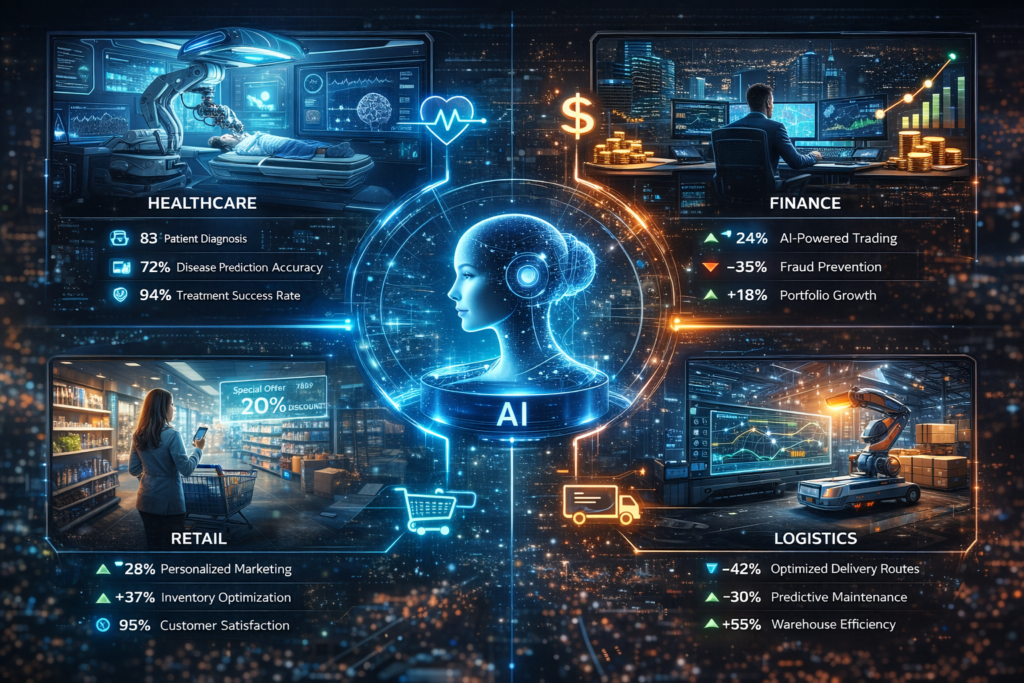
The implementation of these systems is actively solving complex logistical and operational challenges that previously required massive human intervention.
- Retail Inventory and Operations: Retail giant Walmart successfully implemented an advanced “AI Super Agent” designed to ingest massive amounts of real-time point-of-sale data, supply chain metrics, local weather trends, and web traffic. This agentic system autonomously forecasts inventory needs and executes complex restocking protocols without human oversight.
- Healthcare Administration: UCSF Health, which manages 2.5 million outpatient visits annually, utilized simulation environments to train AI agents for complex medical billing inquiries. These agents iteratively learned to handle intricate questions via a “Healthcare Learning Engine,” eventually managing 80% of all billing inquiries autonomously. This implementation drastically reduced the thousands of hours previously spent by human staff answering phones.
- Cybersecurity Defense: In the realm of network security, agentic AI now operates as a continuous, self-healing immune system. Autonomous threat-hunting agents continuously monitor process health across the enterprise. Upon detecting anomalies, they autonomously isolate infected workflows and deploy necessary security patches in mere milliseconds, operating far faster than any human security analyst could respond.
The Collapse of Traditional SaaS Applications
Visionary technology leaders suggest that these agentic developments herald the eventual end of traditional software applications. Microsoft CEO Satya Nadella has publicly argued that the future of computing is about humans acting as “managers of infinite minds,” predicting that standard SaaS applications will ultimately collapse into an all-encompassing AI tier.
Rather than human workers manually navigating multiple siloed databases, an AI agent will seamlessly handle multi-repository Operations. Nadella points out that traditional business applications are essentially just CRUD (create, read, update, delete) databases wrapped in business logic. As AI tiers take over this business logic, traditional user interfaces will become obsolete, replaced entirely by conversational, intent-based orchestration.
The Evolution of Business Intelligence (BI)
Business intelligence is undergoing its most radical reinvention in over a decade. If 2025 was about modernizing data pipelines, 2026 is the year BI becomes an intelligent, proactive, and decision-oriented layer that guides enterprise actions in real time.
Conversational BI Replaces Static Dashboards
Conversational BI has become the default interface for enterprise insight. Natural language processing has entirely replaced static dashboards as the primary entry point for analytics. Instead of manually drilling through complex reports or waiting weeks for data analysts to compile findings, business leaders now simply ask conversational questions.
For example, a VP can ask, “What drove last quarter’s margin erosion in North America?”. The AI-powered BI agent does not just return raw numbers; it actively traces database schemas and returns a synthesized explanation detailing price movements, supply chain slowdowns, and competitor shifts. These agents interpret complex intent, instantly generate necessary visual queries, and proactively guide follow-up analysis.
From “What Happened” to “Why and What Next”
Insights-on-demand integrated with generative AI have moved BI from simply reporting “what” happened to explaining “why” it happened and predicting “what next”. Users seamlessly explore interactive insights, test hypothetical business scenarios, and explore operational changes on demand. This conversational layer completely eliminates the bottleneck dependency on technical data teams, making true self-service analytics a reality for any employee regardless of their technical skill level.
Table: The Transformation of Business Intelligence
| BI Characteristic | Legacy BI Dashboards | Conversational Agentic BI (2026) |
| User Interface | Pre-built, static visual dashboards. | Natural language conversational interfaces. |
| Analytical Depth | Reports strictly on “what happened.” | Explains “why” and simulates “what next.” |
| Accessibility | Requires specialized data analysts to operate. | Fully self-service for non-technical leadership. |
| Response Time | Days or weeks for custom data pulls. | Instant, real-time schema tracing and synthesis. |
AI in Consumer Apps and Everyday Lifestyle
The enterprise sector is not the only area experiencing radical, structural change; consumer technology has been thoroughly infiltrated by invisible, autonomous intelligence. The digital behaviors users now consider perfectly natural are all driven by highly advanced predictive algorithms.
The Era of Hyper-Personalized Mobile Apps
By 2026, consumer mobile applications have moved far beyond generic utility into the realm of hyper-personalization. Shopping and lifestyle applications now function as autonomous personal concierges, intimately learning a user’s tastes, budget constraints, and real-time moods. These platforms feature AI-based style advisors, virtual try-on capabilities, and tools that automatically optimize budgets and search for highly personalized deals.
The concept of “agentic commerce” is fundamentally altering historical consumer habits. Recent data indicates that over 41% of consumers have used dedicated AI platforms for product discovery, with 33% stating they have completely replaced traditional search engines like Google for these tasks. In travel planning, an agent can proactively monitor a user’s calendar gaps, cross-reference their airline loyalty programs, and autonomously book optimal vacation packages without the user ever visiting a traditional booking website.
Autonomous Features in Mobile Ecosystems
Mobile applications across varying consumer sectors are deeply embedding specialized AI functionalities to drastically reduce user friction and enhance engagement.
- E-commerce and Retail: Predictive recommendation engines are driving seamless product discovery and significantly increasing repeat purchase metrics. Autonomous dynamic pricing systems analyze competitor rates and supply chain fluctuations to adjust consumer pricing in real-time.
- Health and Fitness: Wearable technology, such as smart rings and advanced watches, utilizes continuous sensor data to detect falls, analyze heart rate variability, and run complex electrocardiograms (ECGs). These systems proactively alter daily workout intensities to prevent user churn and injury. On-device intelligence ensures that privacy-sensitive medical data is processed entirely locally, maintaining strict security.
- Smart Home Ecosystems: Voice-activated hubs have evolved into proactive, holistic home managers. Rather than waiting for a direct voice command, these systems anticipate household needs based on historical patterns. They map optimal cleaning routes for robot vacuums, adjust climate controls before the user wakes, and independently order depleted household supplies via integrated commerce agents.
Table: AI Features Transforming Mobile Apps
| AI Feature Category | Primary Consumer Benefit | Best-Fit App Industries |
| Conversational AI | Lowers support friction and provides instant resolution. | Fintech, Travel, SaaS, Subscriptions |
| Predictive Analytics | Accurately forecasts retention and adjusts user goals. | Fitness, Retail, Finance, Media |
| Computer Vision | Enables camera-driven interaction and virtual try-ons. | Health, Security, E-commerce |
| On-Device AI | Ensures processing speed, absolute privacy, and offline access. | Healthcare, Biometrics, Smart Home |
SEO Optimization in the Agentic Era
The rapid proliferation of AI agents is also radically transforming digital marketing, search visibility, and Search Engine Optimization (SEO). The traditional, decade-old strategies of keyword stuffing and chasing algorithmic rankings are becoming entirely obsolete in the face of generative search and AI-driven consumer platforms.
The Rise of Answer Engine Optimization (AEO)
In 2026, industry experts warn that the primary threat to traditional SEO is the stubborn attempt to apply legacy ranking logic to highly advanced probabilistic AI systems. Search visibility now strictly depends on becoming the most trusted, usable, and contextually rich input for AI answers and autonomous agent research. This emerging practice is widely known as Answer Engine Optimization (AEO).
Content creators and brands must pivot their entire strategies toward showing up in the historical training data of LLMs and winning the real-time RAG (Retrieval-Augmented Generation) layer. This requires publishing highly authoritative, machine-readable data, maintaining exceptionally strong brand mentions across the web, and structuring all content with deep semantic clarity.
Implementing AI SEO Agents
To survive this shift, organizations are increasingly turning to specialized autonomous AI SEO agents to navigate the complex digital landscape. Tools like KIVA by Wellows and Wordlift act as full-time digital SEO strategists. Instead of relying on generic, outdated keyword databases, these agents connect directly to live Google Search Console data. They autonomously discover untapped “hidden gem” keywords, analyze shifting SERP trends, and generate actionable, step-by-step content strategies.
These advanced systems evaluate competing pages in real-time, identify Latent Semantic Indexing (LSI) keywords naturally connected to the main topic, and dynamically generate H1, H2, and H3 hierarchies. This guarantees that content perfectly aligns with shifting user intent and semantic expectations. By deploying these agents, marketing teams ensure their content remains highly visible to both human readers and the autonomous systems that increasingly browse the web on their behalf.
Table: Trending AI Topics in Google Discover (Feb 2026)
Google’s February 2026 Discover Core Update emphasized showing more in-depth, original, and timely content from websites exhibiting true expertise. The following startups and topics have seen massive search volume spikes as users seek advanced AI solutions.
| Trending Topic / Startup | Search Volume / Status | Growth Rate |
| Datakrew | 260 searches | +5500% |
| Difenz | 880 searches | +5100% |
| Saronic Technologies | 1.9K searches | +5000% |
| Lovable | 550K searches | Massive volume |
| User Interface Design (AI) | 823K searches | Massive volume |
The Pros, Cons, Risks, and Myths of Agentic AI
As with any paradigm-shifting technology, the deep integration of autonomous agents brings both extraordinary operational benefits and substantial, existential risks. Understanding this complex dichotomy is essential for responsible corporate deployment.
The Pros: Unprecedented Efficiency and Scale
The most obvious and celebrated advantage of agentic AI is the exponential increase in operational productivity. Agents process vast, unstructured datasets and execute repetitive, multi-step tasks with a level of precision and speed that human workers simply cannot match. They operate 24/7 without fatigue, enabling true real-time decision-making and continuous business operations.
Furthermore, the technology aggressively democratizes high-level capabilities. As noted with Conversational BI, non-technical staff can now perform complex data analysis. This massive cost reduction through automation allows organizations to scale their operations massively without proportionally expanding their physical workforce or overhead expenses. In customer service, AI handles routine queries instantly, dropping wait times to zero and allowing human agents to tackle only the most highly complex, nuanced issues.
The Cons: Inference Economics and Compute Costs
Conversely, the financial risks associated with scaling autonomous systems are becoming glaringly apparent. A pressing corporate concern is the financial burden known as the “AI infrastructure reckoning”. While token usage costs have dropped 280-fold over two years, the sheer volume of agentic interactions has exploded. Many enterprises are now shocked by monthly cloud computing bills reaching into the tens of millions of dollars.
Organizations are quickly discovering that their existing, cloud-first infrastructure strategies are not designed to scale AI to massive production levels cost-effectively. Consequently, IT leaders are shifting toward strategic hybrid models: utilizing the cloud for elasticity, on-premises servers for consistency, and edge computing for immediate, low-latency processing.

The Risks: Governance and “Death by AI”
More alarming than the financial costs are the profound legal and ethical ramifications of autonomous deployment. Predictive analytics from Gartner suggest that by the end of 2026, legal claims classified as “death by AI” will exceed 2,000. This metric is driven largely by insufficient risk guardrails in deployed autonomous systems.
When “black box” models—systems where the internal decision-making pathways remain opaque to human supervisors—misfire in high-stakes environments like healthcare, finance, or public safety, the real-world consequences are severe. Trust in data remains the absolute primary bottleneck preventing hesitant executives from fully embracing an agent-first strategy. Explainability, robust multi-agent governance, and clean data pipelines are no longer optional best practices; they are strict legal and operational prerequisites.
Furthermore, the “AI dilemma” in cybersecurity presents a terrifying reality. The exact technology meant to give businesses an advantage is actively being weaponized against them by bad actors operating at machine speed. Organizations must desperately secure their AI across four distinct domains: data, models, applications, and infrastructure.
Dispelling the Employment Myth
A persistent and widespread societal myth is that AI will immediately result in mass, catastrophic human unemployment. While the fundamental nature of work is undeniably changing, the reality is a massive structural shift toward a “silicon-based workforce” that still desperately requires human management.
Research data indicates a net gain of 58 million jobs globally. The technology is expected to displace 75 million legacy, rule-based roles while simultaneously creating 133 million new positions centered entirely around AI orchestration, ethical oversight, system maintenance, and high-level strategy. The ultimate goal of enterprise implementation is not the complete eradication of the human worker, but rather the creation of a deeply collaborative, highly lucrative hybrid intelligence.
The Existential Perspective: Abundance vs. Doomsday
Public discourse remains deeply polarized regarding the ultimate trajectory of AGI (Artificial General Intelligence). OpenAI CEO Sam Altman has frequently noted that superintelligent tools have the potential to vastly accelerate scientific discovery, bringing unprecedented abundance and prosperity to humanity.
However, Altman has also warned that a small misalignment in these systems, multiplied by hundreds of millions of users, could cause massive negative impacts. Viral quotes suggesting AI “will probably lead to the end of the world” often circulate without context, but they underscore a genuine industry consensus: the next few years will severely test global society. Leaders like Altman are now calling for international coordination, akin to the IAEA (International Atomic Energy Agency), to manage the rapid deployment of these world-altering technologies.
The Top Autonomous AI Agents of 2026
The enterprise software landscape has quickly saturated with hundreds of competing agentic solutions. To separate genuine utility from marketing hype, organizations must evaluate tools based on their ability to understand context, operate across multiple systems, learn from outcomes, and maintain strict production-level governance. Based on verified user feedback and G2/Capterra benchmarks, several platforms have established dominance.
Table: Leading Autonomous Agents and Enterprise Use Cases
| Agent Platform | Primary Category | Key Use Cases & Capabilities |
| Agentforce | Leading Enterprise Agent | Utilizes predefined topics and dynamic RAG to seamlessly orchestrate multi-step business plans. |
| Harvey AI | Domain-Specific Agent | Specializes in complex contract review and extensive, nuanced legal research for law firms. |
| Claude Code | Autonomous Coding | Focuses on autonomous code generation and Continuous Integration/Continuous Deployment (CI/CD) automation. |
| Clay | Sales Intelligence | Enriches prospect data and conducts autonomous market research for global RevOps teams. |
| HubSpot Breeze | CRM-Native Agent | Manages leads and automates comprehensive marketing campaigns directly within the CRM ecosystem. |
| Box AI Agents | Document Intelligence | Classifies documents, ensures strict compliance, and retrieves knowledge from vast corporate data lakes. |
| Kore.ai | Conversational Support | Provides excellent multi-language support for highly complex customer service dialogues. |
Community sentiment also highlights specific tools that excel in narrow workflows. Developers and CX professionals frequently note that the most successful agents are not necessarily the most autonomous, but rather those that quietly reduce repeat contacts in narrow lanes (like password resets) and escalate cleanly to humans when confused. Popular niche tools include the Frontier Excel Agent, Chatbase for support, and Videotok for autonomous ad creation.
Frequently Asked Questions (FAQ)
To further clarify the immediate impact of autonomous systems on daily operations and strategy, here are concise, direct answers to the most common inquiries regarding AI in 2026.
1. What is the fundamental difference between a traditional chatbot and an AI agent? A traditional chatbot relies on static scripts or basic language models to respond to direct user prompts with generated text. An AI agent is an autonomous system that understands a high-level goal, formulates a multi-step plan, utilizes external software tools, and takes real-world action to achieve that goal without requiring constant human guidance or intervention.
2. How are AI agents directly impacting everyday employee roles? Rather than simply replacing workers, AI agents are fundamentally elevating them. Under the newly established “Human Supervisor Model,” employees transition from executing manual, repetitive tasks to orchestrating and managing teams of specialized digital agents, focusing their efforts strictly on strategy, ethics, and high-level decision-making.
3. Are autonomous AI systems truly secure for enterprise use? Security remains a primary concern and a major bottleneck for global adoption. While agents can autonomously hunt network threats and patch vulnerabilities in milliseconds , they are also highly susceptible to novel attack vectors such as prompt injection and data poisoning. Robust multi-agent governance, clear explainability, and completely clean data environments are required to mitigate these critical risks.
4. What does the industry mean when predicting traditional SaaS applications might “collapse”? Technology leaders, including Microsoft’s Satya Nadella, predict that as AI agents become highly capable of seamlessly interacting with underlying databases and executing multi-repository CRUD operations independently, the need for separate, siloed user interfaces (traditional SaaS) will rapidly diminish. The AI itself becomes the unified interface and logic tier.
5. How exactly will AI agents change online consumer shopping? Agentic commerce is decisively shifting the shopping paradigm from active human browsing to autonomous digital delegation. AI agents will independently monitor user preferences, compare pricing across hundreds of billions of digital SKUs, optimize shipping logistics, and execute purchases on behalf of the consumer, effectively making the traditional digital storefront invisible.
6. How do businesses accurately measure the ROI of AI agents? In 2026, AI success is no longer measured by the sheer number of experimental pilot programs launched, but by tangible, bottom-line business outcomes. Companies track ROI through highly concrete metrics such as the massive reduction in customer service resolution time, improved lead conversion rates, drastically lower operational costs, and overall revenue growth driven by hybrid human-AI workflows.
Conclusion: Preparing for the Agentic Future
The rapid transition from experimental artificial intelligence to highly autonomous, agentic systems marks a permanent, irreversible shift in the global technological landscape. As the expansive market data and real-world case studies from 2026 clearly demonstrate, AI is no longer a peripheral novelty tool utilized solely for content generation or basic coding assistance. It has officially become the core infrastructure driving high-stakes decision-making, optimizing global supply chains, and hyper-personalizing consumer experiences at scale.
Organizations that stubbornly cling to legacy instruction-based computing and siloed data architectures risk immediate obsolescence. The true, lasting competitive advantage in this new era belongs to those who actively embrace the orchestrated digital workforce. This requires immediate investment in robust multi-agent governance, perfectly clean data foundations, and the rigorous upskilling of their human talent into capable, strategic AI supervisors. The future of everyday technology is inherently collaborative—a seamless, powerful integration of human intent and flawless autonomous execution.
Call to Action: Is your organization truly prepared for the agentic revolution, or are you still relying on outdated SaaS models? Share this comprehensive guide with your professional network to spark the critical conversation, leave a comment below with your thoughts on the “Human Supervisor Model,” and explore our related posts on Integrating Multi-Agent Systems in Enterprise Architectures to begin building your digital assembly line today.
AI Is Now Core to Everyday Technology
AI is no longer a side project in tech labs. It is now the engine quietly powering the apps you use, the businesses you interact with, and the decisions made behind the scenes.
Over the past few years, artificial intelligence has shifted from experimental pilots to real, measurable impact across industries. Companies are not just testing AI anymore. They are embedding it into core systems. And the next wave is even bigger: AI that acts autonomously and supports human decision-making in real time.
This shift is reshaping business, software, and everyday technology.
What Does It Mean for AI to Be “Core” Technology?
When we say AI is becoming “core,” we mean it is no longer an add-on feature. It is embedded into the foundation of products, platforms, and workflows.
Artificial intelligence refers to systems that can analyze data, learn patterns, and make predictions or decisions with minimal human intervention. Earlier, AI was mostly used for experiments, chatbots, or basic automation. Today, it powers:
- Search engines and recommendation systems
- Fraud detection in banking
- Smart assistants and productivity tools
- Supply chain forecasting
- Healthcare diagnostics
According to industry reports, over 75 percent of enterprises are now using AI in at least one business function. That number continues to grow as AI becomes cheaper, faster, and more accessible through cloud platforms.
From Experiments to Enterprise Systems
The Early Phase: AI as a Test Project
A decade ago, AI initiatives were limited to research teams. Projects focused on machine learning models trained on small datasets. Results were promising but inconsistent.
Companies treated AI as innovation labs rather than operational tools.
The Current Phase: AI in Production
Today, AI is deeply integrated into:
- CRM platforms
- ERP systems
- HR recruitment software
- Marketing automation tools
- Mobile apps and SaaS platforms
Instead of being optional, AI is embedded directly into workflows. For example:
- E-commerce apps use AI to predict what users will buy next.
- Banks use AI models to flag suspicious transactions instantly.
- Logistics companies use predictive AI to optimize delivery routes.
This is the transition from experimentation to infrastructure.
The Rise of Autonomous AI Systems
One of the biggest trends is autonomous AI.
Autonomous AI systems can:
- Analyze incoming data continuously
- Make decisions within predefined boundaries
- Execute actions automatically
- Learn and improve over time
Unlike traditional automation, which follows fixed rules, autonomous AI adapts to new information.
Example: AI in Customer Support
Modern AI tools can:
- Understand customer queries using natural language processing.
- Check internal databases.
- Offer solutions automatically.
- Escalate only complex cases to humans.
This reduces response times and operational costs.
AI Supporting Decision-Making in Business
AI is not replacing executives. It is enhancing decision-making.
Here’s how AI decision support systems work:
| Step | Function | Impact |
|---|---|---|
| Data Collection | Gather structured and unstructured data | Better insights |
| Pattern Detection | Identify trends and anomalies | Risk reduction |
| Predictive Modeling | Forecast outcomes | Strategic planning |
| Recommendation Engine | Suggest actions | Faster decisions |
Real-World Example
In retail, AI predicts inventory demand based on:
- Seasonal trends
- Customer behavior
- Economic data
- Social media signals
This helps companies avoid overstocking or shortages.
In healthcare, AI tools analyze medical images and flag potential issues earlier than manual reviews, supporting doctors rather than replacing them.
AI in Everyday Apps
AI is already part of daily life:
- Smart keyboards predict what you will type next.
- Streaming platforms recommend shows.
- Maps apps suggest faster routes.
- Email systems filter spam automatically.
These features feel normal now. That is the point. AI has become invisible infrastructure.
Benefits of AI Becoming Core Technology
1. Efficiency
Tasks that once took hours are completed in seconds.
2. Better Decisions
AI processes vast datasets beyond human capacity.
3. Personalization
Apps tailor content, products, and services for individual users.
4. Cost Optimization
Automation reduces manual workload and errors.
Challenges and Concerns
Despite the benefits, there are valid concerns.
Data Privacy
AI relies on large datasets. Poor governance can risk user privacy.
Bias in Algorithms
If trained on biased data, AI systems may produce unfair outcomes.
Over-Reliance on Automation
Blind trust in AI decisions without human oversight can create risks.
The key is responsible AI implementation, including transparency, explainability, and regulatory compliance.
Myths About Autonomous AI
Myth 1: AI will replace all jobs.
Reality: AI is automating repetitive tasks while creating new roles in AI management, data science, and system oversight.
Myth 2: AI is fully independent.
Reality: Most AI systems operate within human-defined boundaries.
Myth 3: Only big tech companies benefit from AI.
Reality: Small businesses now access AI tools through cloud platforms and SaaS providers.
How Businesses Can Implement AI Strategically
If a company wants to move from experimentation to real impact, here is a practical roadmap:
- Identify high-impact use cases.
- Ensure high-quality data infrastructure.
- Start with pilot projects linked to measurable KPIs.
- Scale gradually with monitoring systems.
- Train teams to work alongside AI systems.
AI adoption should align with business goals, not just trends.
FAQ Section
1. What does autonomous AI mean?
Autonomous AI refers to systems that can analyze data, make decisions, and execute actions with minimal human intervention within defined rules.
2. Is AI replacing human decision-making?
No. AI supports decision-making by providing insights and predictions, but humans remain responsible for final strategic decisions.
3. Which industries benefit most from AI?
Healthcare, finance, retail, logistics, manufacturing, and technology are seeing major transformations.
4. Is AI safe for businesses?
AI is safe when implemented with proper data governance, compliance measures, and human oversight.
5. How can small businesses use AI?
Small businesses can use AI tools in marketing automation, customer support chatbots, analytics dashboards, and inventory forecasting.





Post Comment