Artificial Intelligence in Indian Education: How AI is Transforming Children’s Learning
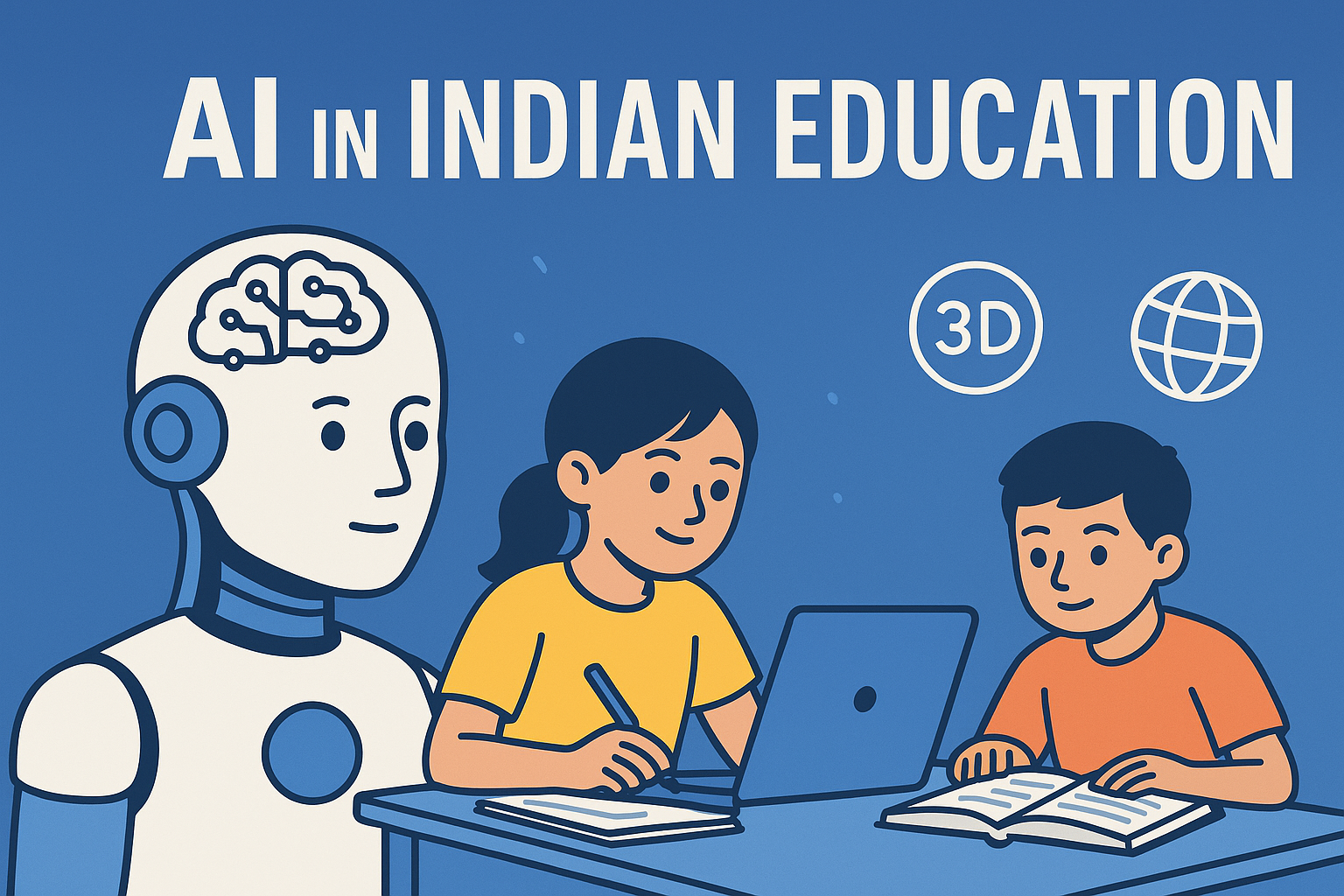
Artificial Intelligence and the Future of Children’s Education in India
Artificial Intelligence (AI) is no longer a distant dream. It is shaping industries, daily life, and now, classrooms. In India, where the education system is vast and diverse, AI holds the potential to become a game changer for children’s learning. But it’s not a simple matter of technology replacing traditional teaching. It is about how AI can complement, improve, and sometimes challenge the way children learn.
Let’s explore how AI is influencing children’s education in India from every possible angle.
The Current State of Education in India
India’s education system is one of the largest in the world, serving over 250 million students. But it faces persistent challenges:
- Large class sizes where individual attention is difficult.
- Unequal access between urban and rural schools.
- Heavy reliance on rote learning instead of creativity and problem-solving.
- Lack of updated resources and trained teachers in many regions.
AI has entered this space not as a replacement, but as a tool that could address some of these gaps.
How AI Can Improve Learning for Children
1. Personalized Learning
Every child learns differently. AI-based platforms can analyze a student’s strengths, weaknesses, and pace of learning. For example, adaptive learning apps can provide extra practice in math for a struggling student while pushing another toward advanced concepts. This individual approach is difficult to achieve in crowded classrooms but possible with AI.
2. Smart Content and Digital Classrooms
AI can create interactive textbooks, 3D models, and even virtual labs. Imagine a child in a remote village learning science through an AI-powered app that visualizes the solar system in 3D. These resources make learning more engaging and reduce dependency on expensive physical labs.
3. Language Translation and Accessibility
India is a country of many languages. AI-powered translation tools can help children learn in their mother tongue while also accessing global content in English or Hindi. Similarly, AI can support children with disabilities through speech-to-text, text-to-speech, or braille converters.
4. Automating Administrative Work
Teachers often spend hours on grading, attendance, and paperwork. AI can handle these tasks, freeing teachers to focus on actual teaching and mentoring students.
5. Early Identification of Learning Gaps
AI systems can track a child’s progress in real-time and alert teachers or parents if a child is struggling with a specific subject. This early intervention can prevent long-term academic gaps.
Opportunities for India
Bridging Rural-Urban Divide
Many rural schools lack qualified teachers. AI-based learning platforms delivered via smartphones can bridge this gap, giving children in remote villages access to quality education.
Supporting National Education Policy (NEP) 2020
The NEP emphasizes skill-based learning, critical thinking, and technology integration. AI fits naturally into these goals, making education more future-ready.
Encouraging Creativity
AI can’t replace imagination, but it can support it. Children can use AI to experiment with coding, design, and even music. This fosters creativity beyond rote memorization.
Challenges and Concerns
1. Digital Divide
Not every child has access to smartphones, internet, or electricity. AI may widen inequalities if access is not made universal.
2. Dependence on Technology
Overreliance on AI tools could reduce children’s critical thinking and problem-solving abilities if not balanced with human teaching.
3. Privacy and Data Security
AI systems collect massive amounts of student data. Without proper regulations, children’s personal information could be misused.
4. Teacher Training
For AI to succeed, teachers need training to use these tools effectively. Without this, AI may remain underutilized in schools.
5. Cultural and Ethical Concerns
Education is not just about knowledge; it is also about values, emotions, and social skills. These cannot be fully replicated by machines. India must ensure AI complements, not replaces, human touch in education.
Role of Government and Policy Makers
The Indian government has already shown interest in AI through initiatives like:
- AI for All program to create awareness.
- Partnerships with edtech companies for digital classrooms.
- NEP 2020’s emphasis on AI-driven learning tools.
However, policies must go beyond adoption. Regulations for data privacy, teacher training programs, and subsidies for rural students are equally important.
Parents’ and Teachers’ Point of View
- Parents may feel hopeful that AI will make their child smarter but worried about screen time and reduced human interaction.
- Teachers may see AI as a helping hand for workload but fear job insecurity if technology takes over.
- Children often adapt fastest. For them, AI-based tools can make learning playful and exciting, provided they are used in balance.
The Way Forward
AI in education should not be about replacing books or teachers but about creating a hybrid model where technology strengthens human learning. India must focus on three key areas:
- Access – ensuring every child, rural or urban, has equal opportunity.
- Balance – blending AI with traditional teaching to preserve creativity and values.
- Ethics – building safeguards around privacy, security, and fair use.
Conclusion
Artificial Intelligence has the potential to reshape children’s education in India. It can personalize learning, bridge rural gaps, and prepare students for a technology-driven future. At the same time, challenges of inequality, ethics, and teacher training must be addressed.
The question is not whether AI will enter Indian classrooms—it already has. The real question is: How will we use AI to create an education system that is smarter, fairer, and more humane for our children?
Artificial intelligence (AI) is transforming the children’s education system in India by making learning more personalized, efficient, and inclusive. From early childhood to higher secondary, AI is being integrated through smart apps, adaptive platforms, curriculum reforms, and innovative policy initiatives, addressing challenges and preparing children for a digital future.
AI in Indian education means the use of intelligent software, algorithms, and data analytics to enhance teaching, student engagement, administration, and learning outcomes. The National Education Policy (NEP) 2020 strongly advocates for digital learning and the widespread adoption of AI across schools and colleges, making it a national priority.
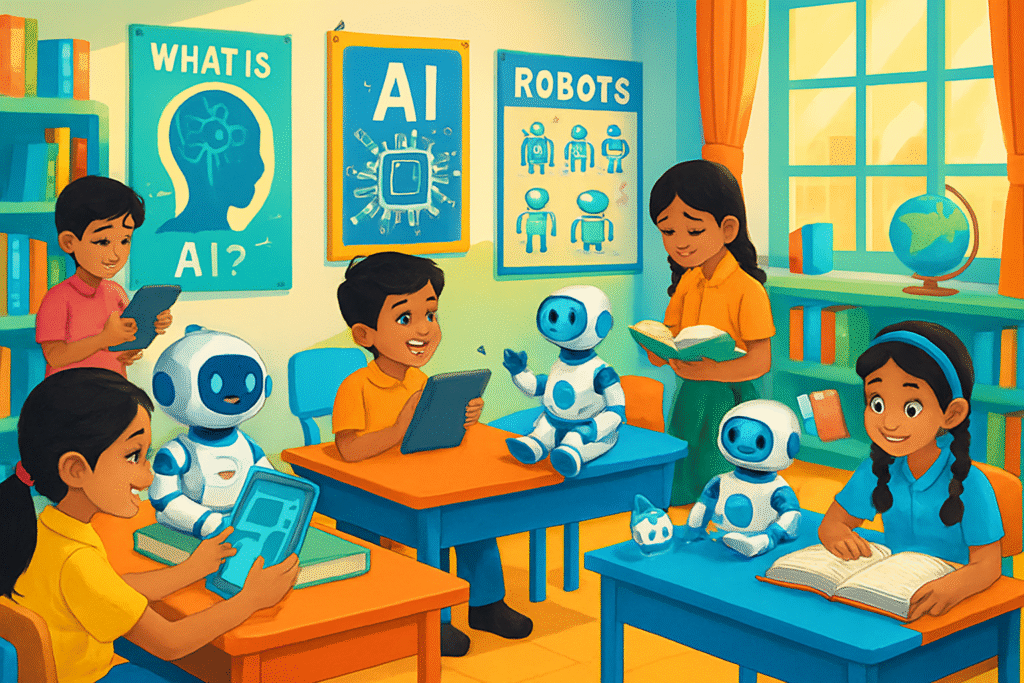
Personalized Learning Experiences
AI enables customized learning paths for each child, adapting to their pace and interests. Adaptive learning platforms like Byju’s, Toppr, and Embibe leverage AI to track progress, identify strengths and weaknesses, and deliver lessons suited to individual needs. Even in remote and underserved regions, AI-powered apps can provide high-quality, engaging experiences on basic smartphones, bridging the digital divide.
- Students receive instant feedback and support in their own language.
- AI generates personalized quizzes, study notes, and flashcards, saving time for teachers and boosting student comprehension.
Bridging Educational Gaps
India’s vast school network faces shortages of teachers, outdated curricula, and unequal access, especially in rural and marginalized communities. AI-driven platforms, like Google’s Appu and government initiatives (DIKSHA, SWAYAM), help address these issues:
- Automated administrative workflows relieve teacher workload, allowing more focus on teaching.
- AI chatbots answer student queries round-the-clock.
- Multilingual content improves reach and quality of education nationwide.
AI in Early Childhood Education
The first years of school are crucial for cognitive, emotional, and social development. AI tutors like Appu use conversational learning, storytelling, and play-based methods to support children aged 3-6, especially in remote areas. This personalized, engaging approach improves school readiness and long-term academic performance.
- Early exposure builds logical thinking, problem-solving, and creativity.
- Scaling AI tools can close the preschool education gap for millions of Indian children.
Curriculum Integration and Policy Initiatives
The CBSE and several state boards now offer AI as a subject for classes IX-XII, with plans to expand into lower grades. NEP 2020 and the National Strategy for Artificial Intelligence encourage curriculum reform and digitization. States like Madhya Pradesh, Uttar Pradesh, and Kerala are pioneering AI courses even for middle schoolers.
- These programs foster future-ready skills in STEM and AI from an early age.
- Skill-based learning and upskilling become accessible for rural and urban children alike.
Parental and Teacher Roles
Parents and educators are vital for guiding children as they explore AI technologies. AI is not just a tool but a partner in education, supporting teachers in differentiated instruction and freeing time for creative activities. Parent involvement can spark curiosity and empower children to build, not just consume, technology.
Administrative and Data-driven Insights
AI streamlines data management, attendance, grading, and school planning. Predictive analytics help identify students at risk of falling behind, enabling targeted support and interventions. Centralized systems like UDISE+ track nationwide trends, guiding policy and resource allocation.
Challenges and Ethical Considerations
Despite rapid progress, AI in Indian schools faces challenges:
- The digital divide limits access in rural or low-income areas.
- Data privacy and algorithmic bias require strict ethical oversight.
- Teacher training and infrastructure upgrades are essential for sustainable integration.
Future Prospects
With government, NGOs, and educational tech companies working together, AI’s potential for Indian children’s education is enormous:




Post Comment